Wales is known as the "Land of Song”. A country’s art seems to reflect its culture. Even as far back as 3-400 B.C the Ancient Greek writings of Aristotle and Plato describe art and culture as a “mimesis” in which culture mimics the mood of its society1. Today, contemporary observers and commentators also witness that the arts express the soul of the community from which it springs.

Song benefits business
Academic study and gathered business data Indicate that song, group singing and music have various benefits, not only for the physical, social and emotional well being of the workforce but also for the enhanced quality and productivity for the business. Singing in choirs encourages better teamwork, builds confidence and self-esteem which are all valuable assets for staff and business alike. In short, singing is good for you and your workplace.
Build your Brand DNA in a simple cost effective way
Group singing has demonstrable results:
- Removes hierarchy: Group singing treats every voice as equally valuable, breaking down hierarchical barriers.
- Shared goals: Employees align around a single objective
- High leadership ranking: UK business surveys by groups like the Royal College of Music rank music top for developing teamwork, communication, and innovation.
- Reduces stress: Singing triggers the release of endorphins and oxytocin, which lower anxiety and build instant social bonds.
- Increases alertness: Deep breathing increases oxygen flow to the brain, leaving workers more energised.
- Boosts morale: Workplace wellbeing programs such as group singing help ease daily tensions and combat loneliness.
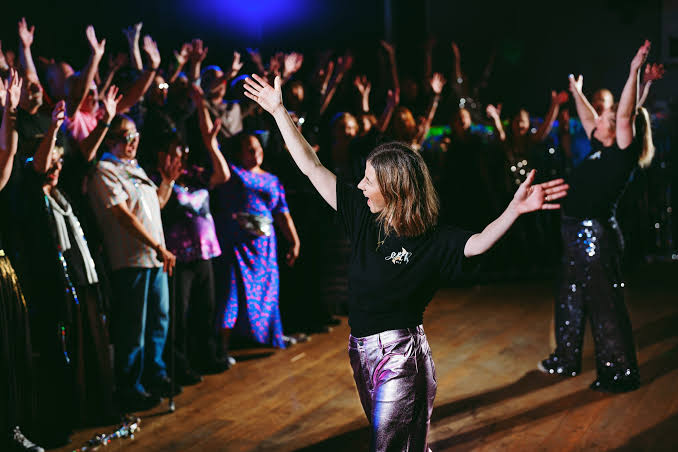
- Super choirs are providing high-energy workplace and community choir sessions across South Wales to boost morale, reduce stress, and improve employee wellbeing
Better for Business
UK research and workplace case studies provide hard evidence that singing makes employees better for business: 5
- Refreshed focus: Global firms like law firm Clifford Chance offer internal singing lessons because a musical break allows employees to return to their desks more focused, creative, and productive.
- Energy boost: Singing physically acts like an internal workout, altering heart rates to a rhythm of "relaxed alertness". This mental shift helps workers stay focused during long hours or complex projects.
- 96% stress reduction: A landmark study by the University of Leicester found that 96% of employees who sang in a workplace choir reported a significant reduction in work-related stress. 6
- 86% lower isolation: The same study showed an 86% drop in workplace loneliness. Mental health issues cost UK businesses billions annually, singing is a cost-effective preventative health benefit.
- The "Icebreaker" effect: Group singing releases oxytocin. This chemical triggers instant bonding, creates strong interpersonal connections much faster than corporate team-building events.
- Cross-department collaboration: Corporate choirs act as a catalyst for relationships. A junior employee singing alongside a senior executive builds cross-tier communication lines, making day-to-day business operations run smoother. 4
Summary Pitch Table for Management
|
Singing Benefit |
Business Impact |
The Data / Source |
|
Stress Reduction |
Lowers absenteeism and burnout |
96% of participants felt less stressed (University of Leicester). |
|
Team Synergy |
Improves project speed and trust |
Fast-tracked trust via oxytocin release (Sidney De Haan Centre). |
|
Employee Retention |
Saves on high recruitment costs |
Higher job satisfaction and talent retention( BBC Workplace Study) |
Steeped in Song
South Wales is a place of intrinsic deeply woven identity. This has developed historically from close knit settlements forging a livelihood as a community. Swansea’s original farming community grew into a world famous industrial hub, triggered by its natural wealth of water and the discovery of rich local coal seams. These local copper smelting resources and skills grew exponentially into a global hub, attracting copper smelting interests initially from Cornwall and the Midlands, then from all over the U.K. and as far afield as Chile, Australia and Cuba 2. The city’s population grew from 6,000 to 100,000 in just 100 years between 1800 and 1900. The close knit streets literally hummed with song as miners organised colliery bands, male voice choirs and musical competitions.
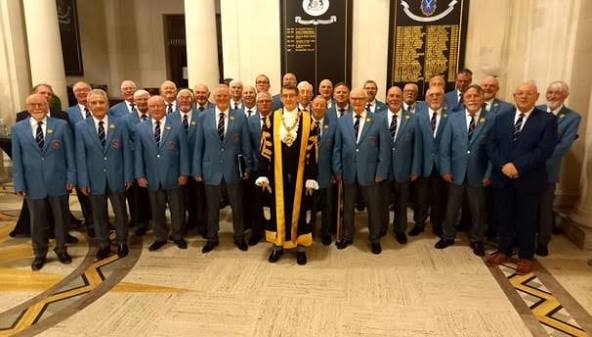
This tradition of singing was enhanced by the Welsh Methodist revival of the nineteenth century. Wales developed a democratic non-conformist church which culminated in disestablishment from the Church of England in 1920. The music of the chapel was further fuelled by the 1904 Welsh Revival – the largest 20th Century Christian revival in Wales. The Revival was so powerful that churches of Wales were filled for many years and Christian revival was sparked throughout the rest of Britain. This flame of renewed Christian faith spread worldwide to Scandinavia, Europe, North America, and even to missions in India, the Orient, Africa and Latin America. In fact, so great was the flame, that the Welsh revival is now acknowledged as the root of the megachurches in the present era! 3
The harmonious voices of Swansea chapel hymn-singing and industrial male voice choirs fuelled a passionate love of music, choral singing, and community performance across Wales. The Welsh language contributed its fervour and lilting musicality so that many different forms of music flourished across this small but power packed country. Many Welsh performers have reached towering heights of fame such as composer Karl Jenkins, singer Katherine Jenkins, opera baritone Bryn Terfel, popular entertainers Aled Jones, Harry Secombe, Tom Jones, Charlotte Church. The hall of fame is huge and we haven’t even mentioned the many successful jazz, rock, folk, and contemporary musicians from Wales.

One of Swansea’s best loved stars sadly died aged 75 years on July 8th 2026. Bonnie Tyler (born Gaynor Hopkins 8 June 1951 from Skewen, near Swansea) is survived by her husband of more than 50 years, Robert Sullivan. Tributes poured in from stars including Catherine Zeta-Jones, Bryan Adams and Rod Stewart. The outpouring of grief from her fans ensured that her hit song ‘Total Eclipse of the Heart’ (originally U.K. and worldwide no 1 in 1983) reentered the charts during the solar eclipse in August. 7
Why not let harmony develop your business
At Parc Felindre, the regional workforce of over 650,000 adults supports the employment opportunity of Parc Felindre’s 16-hectare strategic business park.
Landscaped to a high quality design, the accessible employment land is ideal for occupiers whose business DNA is in tune with the assets of the area.
The broader longterm vision includes a sustainable "live/work" community with up to 800 homes, green spaces, and digital infrastructure connected to the Swansea Bay City Region.
Available NOW!
Contact our agent direct for more information on Business Land with a song in its step.
References
1 https://en.wikipedia.org/wiki/Mimesis
2 https://http://www.swanseamuseum.co.uk/
3 https://en.wikipedia.org/wiki/1904%E2%80%931905_Welsh_revival
4 https://www.bbc.co.uk/programmes/articles/5PrYCBN1fKTwxQGtZ7LzTXj/gaining-management-support
5 https://movingperformance.com/communal-singing-good-business/
6 https://le.ac.uk/news/2019/january/15-singing-work-reduces-stress-loneliness
7 https://www.bbc.co.uk/news/articles/c171j051gejo
Photographs courtesy of
1 Wales Land of Song from the Guardian
2 https://www.wearesuperchoir.com/
3 https://www.swansea.gov.uk/